
Free to download
Free Printable Worksheets for Reading, Memory and Thinking Skills (Grades 1–13)
EyeQBoost’s worksheet library gives parents and teachers free printable PDFs for Grades 1–13: reading comprehension passages, working memory and visual processing exercises, attention and reasoning puzzles, and print-and-cut classroom kits. Every series has five sheets per grade, written in UK English. Download three free; a free account unlocks the rest.
Prefer screens? Every skill here has a matching Brain Game.
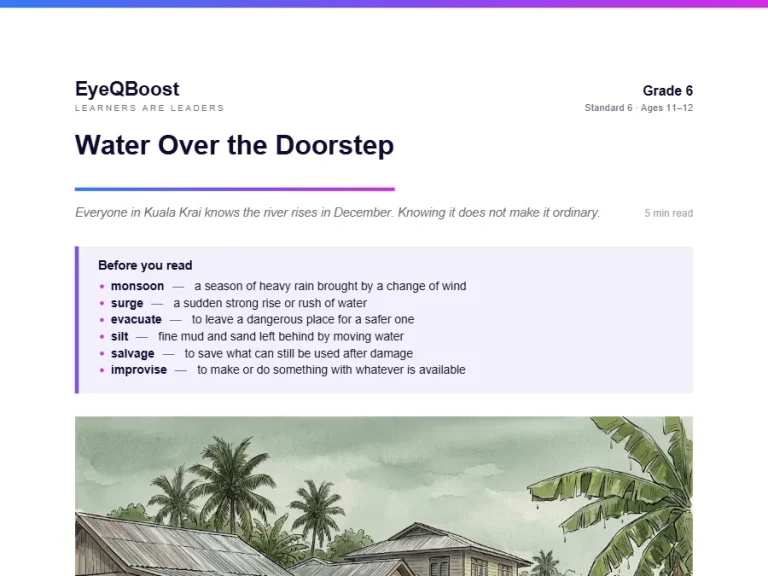
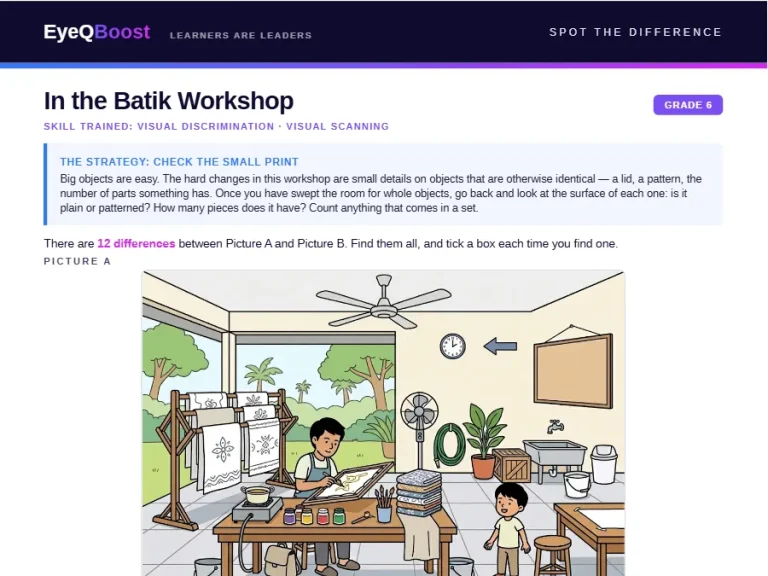
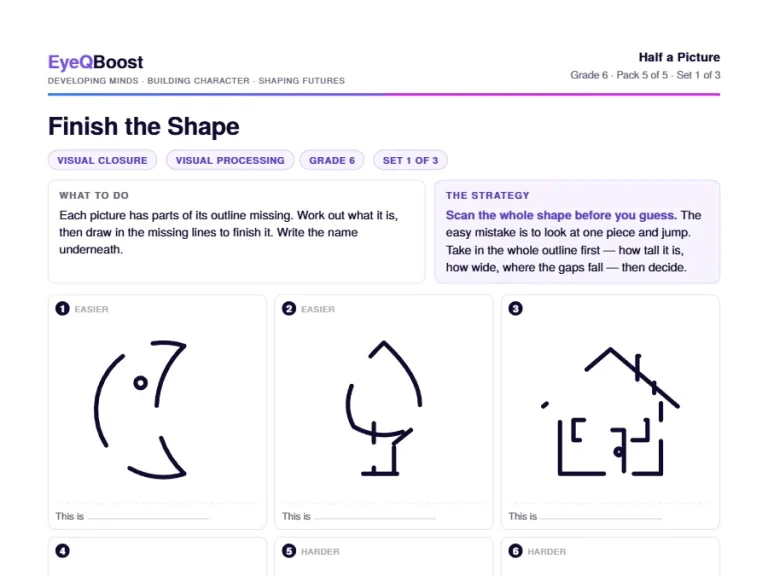
Try these free, no account needed
Free account
Unlock every worksheet, free
Create a free account in 30 seconds to download every printable worksheet for Grades 1–13 and play the whole Brain Games library.
- Every worksheet, Grades 1–13: reading, visual & cognitive skills, reasoning, hands-on kits and emotional resilience
- 24 Brain Games with points, levels and a leaderboard
- Progress saved to your account, on any device
- For parents, students and teachers. Always free.
Grades 1–13
Free worksheets for every grade and every ability
Everything on our Resources page is free, and together it covers all school-age levels, from a child’s first year of school right through to pre-university. Every resource is written to cater to all abilities, so whether your child is building confidence or ready for a stretch, there is a place to start that fits.
Browse by topic below, or choose your child’s grade to see only the worksheets for them. Not sure where to begin? Try a grade below, work upwards, or message us and we will help you choose.
Reading comprehension worksheets
Exercises for reading comprehension, vocabulary, attention to detail and recall.
Reading WorksheetsReading comprehensionGrades 1–13Short, engaging stories and articles that build understanding, vocabulary and reading confidence.
Grade 1
Grade 2
Grade 3
Grade 4
Grade 5
Grade 6
Grade 7
Grade 8
Grade 9
Grade 10
Grade 11
Grade 12
Read & RecallMemoryGrades 1–13Read carefully, then see how much you can remember. Builds attention to detail and recall.
Working memory worksheets
Exercises for working memory, visual memory, memory strategies and spaced retrieval.
Span LadderWorking memoryGrades 2–13Climb rung by rung, holding a little more in mind each time to stretch working memory.
Prefer screens? Play the matching Brain Game: Span Ladder
Look, Cover, DrawVisual memoryGrades 1–8Study a row of shapes, cover it, then draw it from memory, learning a new memory strategy on every sheet.
Memory Palace StarterMemory strategiesGrades 6–13Learn the memory palace technique: place what you need to remember along a familiar route, then walk it back.
Tomorrow TestSpaced retrievalGrades 4–13Study once, then recall today, tomorrow and next week to move new facts into long-term memory.
Visual perception worksheets
Exercises for visual tracking, visual discrimination, visual closure and mental rotation.
Line of SightVisual trackingGrades 1–8Train the eye movements behind reading: landing accurately from point to point and following a line without losing it.
Prefer screens? Play the matching Brain Game: Line of Sight
Spot the DifferenceVisual discriminationGrades 1–8Compare two busy, familiar scenes and find everything that has changed.
Half a PictureVisual closureGrades 1–6Recognise everyday things from only part of the picture. Scan the whole shape before you guess.
Same Shape, New AngleSpatial reasoningGrades 3–10Spot the same shape when it is turned, flipped or folded, from flat shapes up to cube nets.
Prefer screens? Play the matching Brain Games: Shape Stacker · Roll the Cube
Attention and processing speed worksheets
Exercises for processing speed, visual scanning and divided attention.
Symbol CodeProcessing speedGrades 3–13Use the key to crack the code quickly and accurately, building processing speed and visual scanning.
Two Things at OnceDivided attentionGrades 5–13Keep two tasks going at the same time without losing track of either.
Logic and reasoning worksheets
Exercises for pattern reasoning, deductive reasoning and cause and effect.
What Comes NextPattern reasoningGrades 1–13Check one change at a time to crack shape sequences and grid puzzles, then put the rule into words.
Logic GridDeductive reasoningGrades 4–13Work clue by clue, ticking and crossing the grid until only one answer is left standing.
Because, ThereforeCause and effectGrades 5–13Find the cause, follow the effect and test each “therefore” to build careful, evidence-based reasoning.
Printable classroom kits: print, cut and play
Hands-on kits for story sequencing, spatial reasoning, visual memory, puzzle design, number sense and reading focus.
Sequence ScrambleStory sequencingGrades 1–6Cut out the cards and put each story or process back in the right order.
Grade 2
Grade 4
Grade 5
Piece by PieceSpatial reasoningGrades 1–8Cut out tangram and pentomino pieces, then turn and fit them to build each challenge shape.
Memory PairsVisual memoryGrades 1–13Print, cut and play a themed matching game, holding each card’s place in mind to find every pair.
Prefer screens? Play the matching Brain Game: Memory Pairs
Puzzle Maker’s PackPuzzle designGrades 3–8Six blank templates for building logic grids, codes, mazes and more to swap with a friend.
Grades 3–8
One Die, Ten GamesNumber senseGrades 1–6Ten quick games that need nothing more than one die and a pencil, building number sense, memory and strategy.
Reading Window & Tracking RulerReading focusGrades 1–8Print and cut a reading window and tracking ruler that help children keep their place on the line and read with less effort.
Grades 1–2
Grades 3–5
Grades 6–8
On the way
What’s coming
More printable worksheets and simple activities across our five pillars, written for Malaysian learners at every school stage and every ability.
Emotional resilience activities
Gentle activities for naming feelings, calming down and bouncing back from setbacks.
Metacognition (thinking about thinking)
Simple prompts that help children plan, check and reflect on how they learn best.
Financial literacy and leadership
Everyday money challenges and small leadership tasks that build confidence and good habits.
Browse resources
Filter by type and school stage to find the right sheet for your child. New resources will appear here as soon as they are ready.
More resources are on their way
We're preparing free worksheets for emotional resilience, metacognition, mind activation, financial literacy and more. Check back soon!
What the research says about practising these skills
Children get better at the skills they practise, and the habits with the strongest evidence behind them are answering from memory, spacing practice out over several days, and building visual and spatial skills. No worksheet raises general intelligence on its own, so each EyeQBoost series targets one specific, well-researched skill rather than vague “brain training”.
Read the research behind each series
Answering from memory beats rereading. When researchers compared ten common study techniques, practice testing and spreading practice over time were the only two rated highly effective; rereading and highlighting were rated low (Dunlosky et al., 2013). The finding holds outside the lab: across 50 classroom experiments with nearly 5,400 students, more than half showed medium or large gains from retrieval practice, across different ages and subjects (Agarwal, Nunes & Blunt, 2021). That is why Read & Recall asks children to cover the passage before answering, and why Tomorrow Test brings the same questions back a day and a week later.
Working memory and attention hold learning together. Working memory is the mental workspace that keeps information in mind while a child uses it: remembering a three-step instruction, holding a sentence while writing it down, or carrying a number in a sum. Children with weaker working memory often forget instructions and lose their place in a task, which slows their learning (Alloway, 2006). Practice reliably improves the trained skill, but the evidence that it transfers on its own to reading or maths is weak (Melby-Lervåg, Redick & Hulme, 2016). So Span Ladder and Memory Palace Starter also teach strategies children can use in real schoolwork, such as chunking and the method of loci, rather than drilling memory for its own sake.
Visual and spatial skills support reading, maths and science. In six large studies that followed children from the start of school, fine motor skills (such as copying shapes) and attention predicted later reading and maths; together with general knowledge, they predicted later achievement better than early reading and maths scores alone (Grissmer et al., 2010). Spatial skills are also among the most trainable: a review of 217 studies found training gains were lasting and carried over to spatial tasks that had not been practised, and spatial ability strongly predicts success in science, technology, engineering and maths (Uttal et al., 2013). Line of Sight, Half a Picture, Same Shape, New Angle and our print-and-cut kits are built on this work.
How to use these worksheets at home and in class
Little and often works best: one worksheet of 10 to 15 minutes, a few times a week, at a level where your child gets most answers right. Then come back to the same skill a few days later. Each series has five sheets per grade, so one series lasts about five weeks at one sheet a week.
Tips for parents and teachers
At home. Start one grade below your child’s school year and move up once a sheet feels comfortable; learning is strongest when children get roughly 80% of answers right, enough to stay confident while still being stretched (Rosenshine, 2012). Read the instructions together, especially with younger children, so that the task tests the skill rather than their memory for instructions. Mark the sheet straight away and talk through anything they got wrong while it is fresh. Rather than finishing a whole grade of one series, mix two or three series across the week and return to earlier sheets after a few days: spacing and mixing practice make learning last longer (Dunlosky et al., 2013). Where a series has a matching Brain Game, the game makes a good reward or a quick warm-up for the same skill.
In class. Use a sheet as a five-minute lesson starter, a task for early finishers, or a short small-group intervention. Effective teachers begin lessons with a brief review and come back to material weekly and monthly (Rosenshine, 2012), and the five-sheets-per-grade format fits that rhythm: one sheet a week takes a group through a series in half a term. Read & Recall and Tomorrow Test work well as low-stakes quizzes, marked together in class rather than graded. The printable kits, such as Memory Pairs, Sequence Scramble and the Reading Window & Tracking Ruler, suit stations and quieter corners. You are welcome to photocopy any worksheet for your own class.
FAQs
Are the worksheets free?
Yes. Three worksheets are free to download straight away, with no account. A free EyeQBoost account (no card needed) unlocks every worksheet in the library, from Grade 1 to Grade 13, plus each new series as we add it. Everything is a printable PDF you can use at home or in class.
What grades and ages do the worksheets cover?
The library covers Grades 1 to 13, roughly ages 6 to 18, from a child’s first year of school through to pre-university. Worksheets are written for an international audience and are not tied to one national curriculum. Each grade steps up gently from the one below, so if your child sits between two grades, start with the lower one.
How many worksheets should my child do a day?
One sheet, about 10 to 15 minutes, a few times a week works better than a long session. Coming back to a skill on different days and answering from memory are the two study habits with the strongest evidence: a major review of ten learning techniques rated practice testing and spaced practice the most effective (Dunlosky et al., 2013).
Can teachers photocopy the worksheets for a class?
Yes. You are welcome to print and photocopy them for your own students or children, at home, in class or in tutoring sessions. Please do not resell them or upload the files to other websites; share a link to this page instead, so others always get the latest version. [TODO: confirm licence wording]
Which worksheets go with which Brain Games?
Several series have a matching online game, so children can practise the same skill on paper and on screen. Span Ladder pairs with the Span Ladder game, Line of Sight with Line of Sight, the Memory Pairs kit with Memory Pairs, and Same Shape, New Angle with Shape Stacker and Roll the Cube. Look for the game link on each series card.
Be the first to know
Send us a message and we will let you know as soon as new free resources are ready.
Social-emotional learning worksheets
Exercises for naming emotions, pausing before reacting and challenging unhelpful thoughts.
Feelings FinderNaming emotionsGrades 3–8Recognise, name and pause on a feeling, ask why it came, then choose a calm response.
Grades 3–5
Grades 6–8
Thought DetectiveChallenging thoughtsGrades 5–13Catch unhelpful thoughts, weigh up the evidence and swap them for fairer, more balanced ones.
Grades 5–6
Grades 7–9
Grades 10–13